The Dallas Cowboys fanbase is reeling in chaos after one of the most shocking trades in recent franchise history. Just days after the team announced the blockbuster deal that sent superstar pass rusher Micah Parsons to the Green Bay Packers in exchange for defensive tackle Kenny Clark, emotions across Texas have boiled over into a firestorm — quite literally. Viral videos surfaced showing groups of furious Cowboys supporters burning Parsons’ jerseys in parking lots, living rooms, and even outside AT&T Stadium, each clip spreading like wildfire across social media.
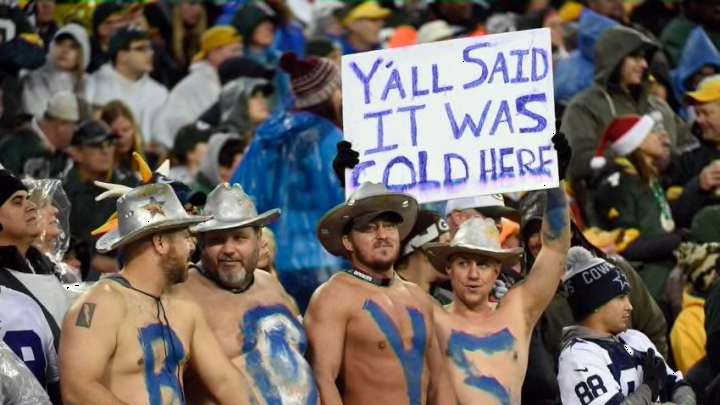
The dramatic images captured a fanbase split down the middle. For many, Parsons was not just a player but the heart and soul of the Cowboys defense, the cornerstone of their championship aspirations. Watching him leave in exchange for Clark — a proven but older defensive tackle — felt like betrayal. “This is insanity,” one fan shouted in a video as he tossed a Parsons jersey into a flaming barrel. “He was our future. We just gave him away.” Another video showed a father and son ripping up Parsons posters, the child in tears as his father muttered: “Jerry Jones has lost his mind.”
The backlash was immediate and relentless. Hashtags like #CowboysBurnout and #ParsonsForever trended across Twitter and TikTok, with fans venting their disbelief. Some accused team management of sabotaging the roster, while others declared they were done supporting the franchise altogether. Memes mocked the Cowboys for “trading away a Ferrari for a pickup truck,” and local talk shows were flooded with angry calls demanding accountability from the front office.
Yet amid the flames and fury, another narrative quickly emerged — one of gratitude and defense of Parsons himself. While some burned his jersey in rage, others posted heartfelt videos holding up his number 11 with pride. “He gave his all to the city,” one lifelong fan said in an emotional clip that has already garnered millions of views. “Every sack, every tackle, every moment, Micah left it all on the field. Don’t burn his jersey — hang it on your wall.”
Supporters pointed out that Parsons had no say in the trade. As one fan wrote: “Blame management, not Micah. He didn’t walk away. He was pushed.” Others highlighted his legacy in Dallas, from Defensive Rookie of the Year honors to anchoring one of the NFL’s most feared pass rush units. For many, the notion of turning against him felt deeply unfair.
NFL analysts echoed that sentiment. On ESPN, Marcus Spears — himself a former Cowboys defensive lineman — blasted the jersey-burning trend. “Y’all got it wrong. Micah didn’t quit on you. The front office made a decision, and it’s one a lot of us don’t agree with. But don’t take it out on the kid who gave everything he had.”
Still, the optics of the backlash have created a media frenzy. Clips of Cowboys fans torching Parsons’ jerseys have been replayed on highlight shows and news segments nationwide, feeding into the perception of Dallas as a franchise perpetually surrounded by chaos and drama. Rival fanbases, especially those of the Eagles and Giants, have gleefully joined in mocking the Cowboys. “Only in Dallas do you burn the jersey of your best player,” one Eagles fan tweeted.
For Parsons himself, the trade and its aftermath represent a whirlwind of emotions. The star pass rusher has not yet spoken directly about the backlash, but sources close to him say he was “hurt but not surprised” by the intensity of the reactions. He reportedly views his time in Dallas with pride and is already shifting his focus toward making an impact in Green Bay. “Micah’s motivated,” one insider revealed. “He wants to prove to the world — and maybe to the Cowboys — that trading him was the biggest mistake they ever made.”
Meanwhile, Kenny Clark, the player acquired in the deal, has been thrust into an unenviable position. At his introductory press conference, he faced questions not about his own role but about whether he could ever fill the void Parsons left behind. “Look, Micah’s an incredible player,” Clark admitted. “I’m just here to do my job and give everything I can to this team. I know I can’t replace him, but I’ll do my best to earn the fans’ trust.”
Cowboys head coach Mike McCarthy attempted to calm the storm, insisting the trade was part of a larger strategy to balance the roster. “We love Micah, and we appreciate everything he did for this organization,” McCarthy said. “But sometimes you make tough decisions to build the best team possible. Kenny Clark brings leadership, experience, and a skill set we value greatly.” His words, however, did little to soothe angry supporters who still see Parsons as irreplaceable.

The debate has now become one of identity. Are the Cowboys a team that sacrifices stars for balance, or a franchise that repeatedly fumbles away generational talent? Fans remain deeply divided, with some calling for patience to see how the move plays out, and others already declaring it a disaster.
In Green Bay, the mood could not be more different. Packers fans have embraced Parsons as the missing piece to elevate their defense to elite status. Social media is flooded with images of him photoshopped into green and gold, alongside captions like “Our next legend” and “Dallas’ mistake, our miracle.” The contrast between the two fanbases — one burning jerseys, the other celebrating — could not be starker.
As the dust settles, one truth remains clear: Micah Parsons has left a complicated legacy in Dallas. For some, his departure is a wound too fresh to forgive. For others, he remains a beloved figure who should be honored, not vilified. And for Parsons himself, the controversy only adds fuel to the fire as he begins a new chapter in Green Bay.
Ultimately, the trade and its aftermath underscore the volatile nature of modern sports fandom. Loyalty, passion, and anger often blur together, producing moments as dramatic off the field as on it. Whether Cowboys fans will one day look back on the jersey burnings with regret remains to be seen. What is certain, however, is that the name Micah Parsons will linger in Dallas for years — as a reminder of what was, and what might have been.


