In a season already crackling with anticipation, Caitlin Clark’s long-awaited return to the WNBA hardwood was billed as must-watch basketball. Yet what unfolded against the undefeated New York Liberty was far more than a comeback — it was a spectacle that redefined expectations. After a grueling 20-day layoff nursing injury, Clark didn’t simply ease her way back into action; she stormed onto the court with the poise of a veteran and the fire of a rookie determined to rewrite the script.
Her stat line alone — 32 points, 9 assists, and 8 rebounds — reads like a career night for most players. But for Clark, it was a masterclass in control, vision, and competitive brilliance. Every possession carried intent, every pass sliced with precision, and every deep three was a dagger that electrified the crowd and silenced doubters. This wasn’t just talent on display; it was resilience, swagger, and the undeniable aura of a generational star.
The Liberty, flawless until that night, found themselves shaken. Defenders switched, traps were set, and physical play ramped up to uncomfortable levels — yet Clark remained unmoved, her composure unshaken. With each bucket and assist, she reminded not only the Fever but the entire league that her impact cannot be contained.
What started as a question of how Caitlin Clark would look in her return quickly transformed into something much bigger: a declaration that she isn’t just back — she’s here to shift the balance of power in the WNBA.

The atmosphere was thick with a mixture of excitement and uncertainty. How would Clark look after her time on the sidelines? Would the Indiana Fever, a team still finding its identity, be able to challenge the powerhouse that is the New York Liberty? The questions hung in the air, but from the moment the ball was in her hands, Clark began to provide the answers. Her very first trip up the court was a sign of things to come, a perfectly executed no-look pass that sliced through the Liberty defense and found its target with pinpoint accuracy. It was a play that showcased not just her vision, but her confidence, a swagger that had been sorely missed.
In the opening quarter, Clark was the consummate floor general, a maestro orchestrating the offense. Before she even attempted a shot, she had dished out three assists, each one a testament to her court awareness and playmaking ability. She was probing the defense, identifying weaknesses, and setting up her teammates for success. It was a patient and calculated approach, the calm before the storm. And then, the storm arrived.
With the clock winding down in the first quarter, Clark unleashed a torrent of scoring that left the Liberty and the entire arena stunned. In a breathtaking display of marksmanship, she drained three three-pointers in under a minute, two of which were from a distance that can only be described as “Steph Curry range.” These weren’t just shots; they were declarations of intent, each one a dagger that pierced the heart of the Liberty defense. The crowd erupted with each successful attempt, a crescendo of noise that mirrored the escalating brilliance of the player they had come to see.
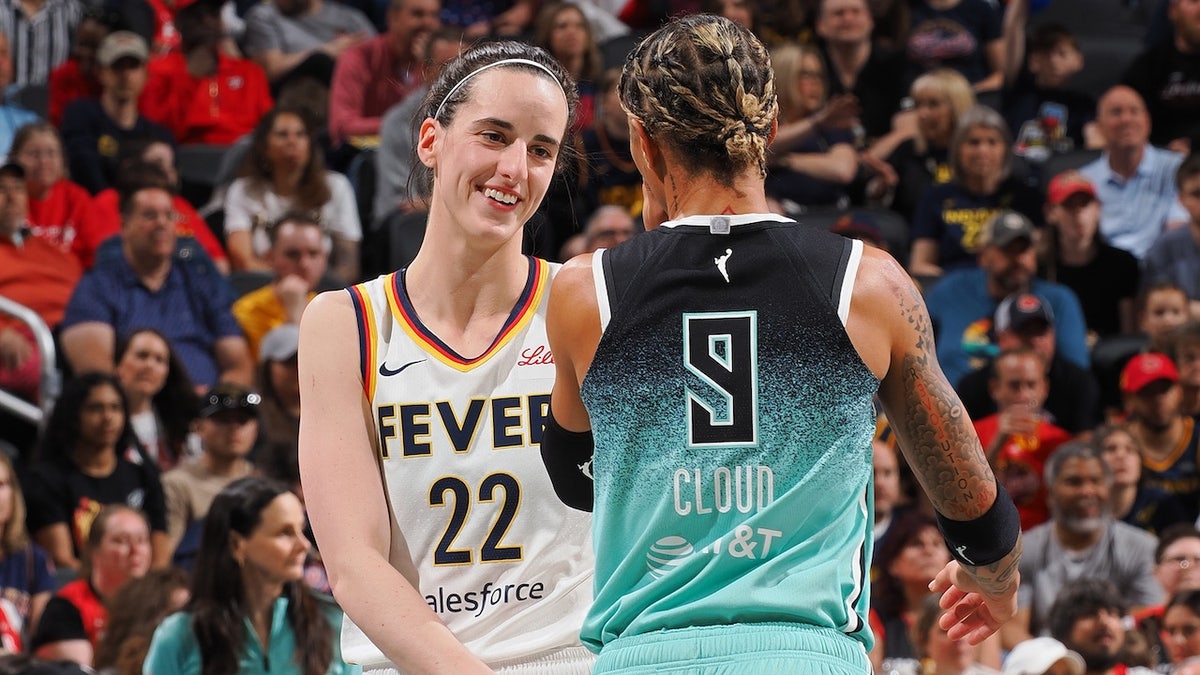
The second quarter saw Clark continue her offensive onslaught. She added two more three-pointers, making it five in a row, with three of them coming in a jaw-dropping 38-second span. The Liberty, a team known for its defensive prowess, was at a loss. They threw different defenders at her, they tried to trap her, but nothing seemed to work. Clark was in a zone, a state of basketball nirvana where the rim looked as wide as the ocean.
As the game wore on, the physicality of the Liberty’s defense intensified. Natasha Cloud, one of the league’s premier defenders, was tasked with trying to slow down the phenom, and she employed what some have described as a “dirty playbook.” There were bumps, there were shoves, and there was a clear attempt to get under Clark’s skin. But if the intention was to rattle her, it had the opposite effect. Clark remained unfazed, a picture of calm and composure in the face of adversity. She continued to make deep shots, to thread laser-like passes to her teammates, and to play with a poise that belied her rookie status.
By the time the final buzzer sounded, Clark had amassed a stat line that was nothing short of extraordinary: 32 points, 9 assists, and 8 rebounds. She had also set a new franchise record with seven three-pointers in a single game. And while the Fever ultimately fell to the Liberty, the result of the game seemed almost secondary to the brilliance of Clark’s performance. The celebration of the Liberty players after the game was telling; it wasn’t the joyous revelry of a team that had just secured another victory, but rather the relieved exhalation of a team that had survived a serious challenge. It was as if they had just won a playoff elimination game, a testament to the fear that Clark had instilled in them.
In the aftermath of the game, the WNBA was abuzz with talk of Clark’s return. Coaches, players, and analysts alike marveled at her fearlessness, her skill, and her undeniable impact on the game. Her performance was more than just a great individual effort; it was a sign of a potential shift in the league’s balance of power. With Clark at the helm, the Indiana Fever were no longer just a young team with potential; they were a legitimate threat, a team capable of competing with the league’s elite.
And as for Clark herself, her post-game comments were a clear indication of her mindset. There was no hint of moral victory, no satisfaction in a close loss. There was only a quiet determination, a burning desire to win. Her words were simple, yet they carried a weight of promise and a hint of a brewing rivalry: “We’ll see them again.” It was a message to the New York Liberty and to the rest of the WNBA that this was just the beginning. The return of Caitlin Clark was not just a comeback; it was a coronation, the arrival of a new queen on the WNBA stage. And the league will never be the same.


