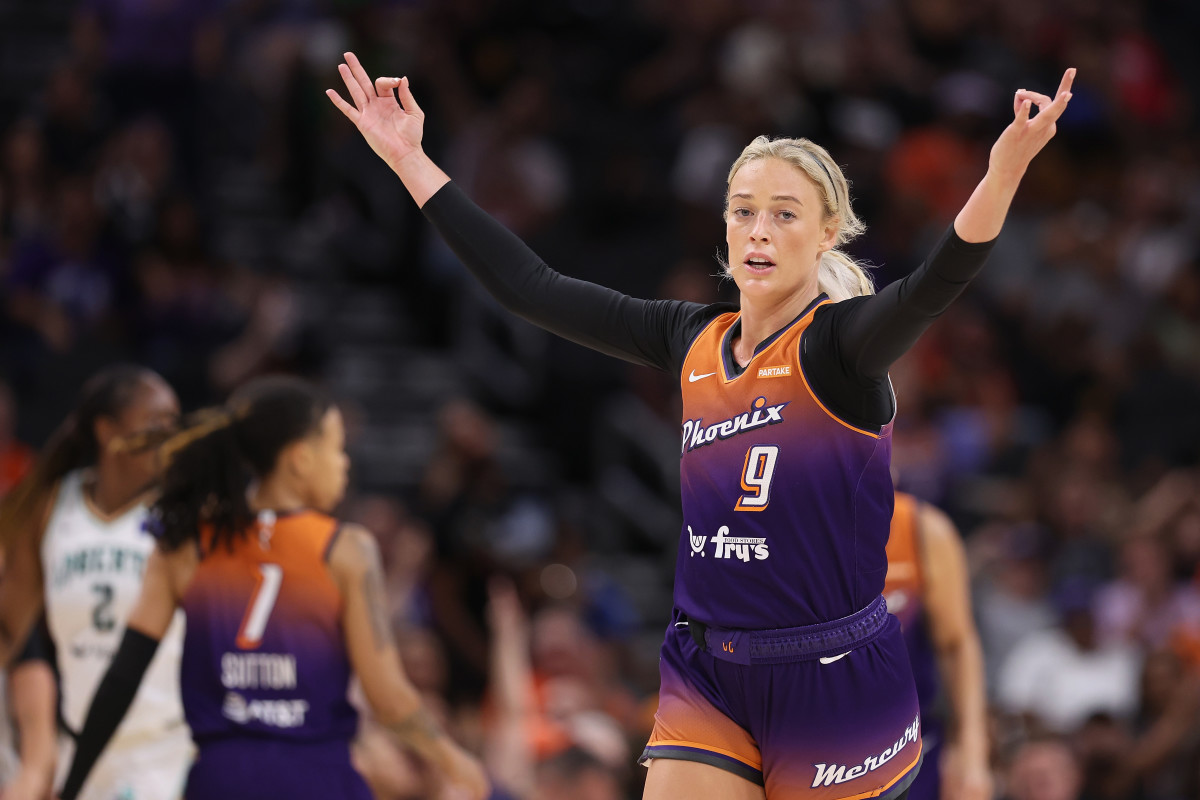
In the world of professional sports, success is often measured in contracts, championships, and statistics. Yet sometimes, all it takes is one electrifying moment—a spark that ignites far beyond the court and reshapes a player’s entire career trajectory. For Sophie Cunningham, a rising star in the WNBA, that moment came when she made a fiery stand to protect her teammate Caitlin Clark. What followed was a viral storm that transformed her image, attracted millions of eyeballs, and, most importantly, opened the floodgates of endorsement deals that now dwarf her league salary.
This isn’t just a story about basketball. It’s about the collision of sport, culture, and commerce—and how Cunningham’s sudden burst of fame provides a case study in the growing economic power of women’s sports.

The Moment That Changed Everything
The play itself was brief but unforgettable. Caitlin Clark, the Indiana Fever rookie whose arrival has already shifted the landscape of women’s basketball, was on the receiving end of yet another hard foul. This time, however, Cunningham refused to stand by. She stepped in with intensity, delivering her own response that spoke louder than words: her teammate’s safety—and dignity—would be defended.
Within minutes, clips of the moment spread across social media. Millions of views poured in, hashtags trended, and the narrative shifted from game strategy to something much bigger. Cunningham wasn’t just a role player anymore; she was the enforcer, the protector, the embodiment of loyalty in a league where rivalries and friendships often blur under the bright lights.
For fans, especially in an era where authenticity matters, this was magnetic. Brands quickly recognized the value of what had just unfolded.
WNBA Salaries: A Fraction of the Picture
To fully appreciate what happened next, one must understand the financial reality of the WNBA. Cunningham’s league salary hovers around $100,000—a figure that might sound generous to the average worker but pales in comparison to male athletes in the NBA, where even bench players often earn millions annually.
For years, WNBA players have relied on overseas contracts, offseason hustles, and brand endorsements to supplement their income. Cunningham knew this reality well, but nothing could have prepared her for the sudden financial windfall that arrived after her viral moment.
Endorsements Pour In
Sports marketing experts estimate that within weeks of the incident, Cunningham secured endorsement opportunities worth several times her annual salary. Athletic apparel companies, lifestyle brands, and even non-sports corporations lined up to sign her.
The reasons were clear:
-
Cultural Resonance – The narrative of “protector” sells. Cunningham wasn’t just another athlete; she was a character in a broader story of loyalty, toughness, and standing up for others. Brands knew audiences would connect emotionally.
-
Visibility Surge – Social media metrics spiked. Cunningham’s follower count on Instagram and X skyrocketed, providing brands an instant platform to reach engaged fans.
-
Market Timing – Women’s sports, particularly basketball, are in the middle of a renaissance. Caitlin Clark’s arrival has supercharged interest, and Cunningham’s viral moment allowed her to ride that wave at the perfect time.
Industry insiders suggest that her combined endorsement deals could exceed seven figures annually, effectively making her WNBA salary look like pocket change.
The Power of a Viral Moment
What makes Cunningham’s story so compelling is how it underscores the unpredictable nature of modern sports fame. A player’s financial destiny is no longer tied exclusively to performance stats or championship rings. Instead, moments that resonate culturally—whether a fiery defensive stand, a passionate post-game speech, or a viral highlight—can eclipse years of steady but quiet play.
Consider how Naomi Osaka’s activism amplified her brand, or how Megan Rapinoe’s outspoken leadership turned her into a household name. Cunningham’s moment fits into this lineage. She didn’t just make a play; she made a statement. And in today’s marketplace, statements can be monetized.
The Caitlin Clark Effect
Of course, Cunningham’s story cannot be separated from Caitlin Clark’s meteoric rise. The rookie phenom has already been credited with record-breaking television ratings, sold-out arenas, and unprecedented attention for the WNBA.
Clark is a gravitational force—drawing fans, media, and corporate dollars. Those who align with her, either as teammates, rivals, or defenders, benefit from her spotlight. Cunningham’s viral moment was amplified precisely because it involved Clark. The lesson? In women’s sports, association with superstar figures can accelerate brand equity almost overnight.
Reframing the Economics of Women’s Sports
Cunningham’s endorsements also highlight a shifting dynamic: the financial ceiling for female athletes is no longer fixed by league salaries. Instead, it’s increasingly shaped by cultural impact, digital reach, and the ability to command attention in a crowded marketplace.
Brands don’t just see athletes as performers—they see them as influencers, storytellers, and ambassadors. Cunningham’s rise is proof that a single highlight can redefine an entire career arc. And for women’s sports, this represents both opportunity and challenge.
-
Opportunity because it demonstrates the untapped commercial value of players who previously might have been overlooked.
-
Challenge because it reinforces the idea that women must go viral—or be connected to superstars—to maximize their financial opportunities, rather than relying on structured league compensation.
Lessons for Athletes and Brands
Cunningham’s story offers a roadmap for athletes navigating the modern era:
-
Authenticity Wins – Cunningham didn’t manufacture her moment; it came from genuine passion on the court. Fans and brands alike crave authenticity, and it cannot be faked.
-
Digital Presence Matters – Viral moments don’t exist in a vacuum. They spread because platforms like Instagram, TikTok, and X amplify them. Athletes who nurture their digital presence are better positioned to capitalize.
-
Narratives Drive Value – Beyond skills, athletes who embody stories—protector, underdog, trailblazer—unlock emotional resonance that brands want to align with.
-
Preparation is Key – Cunningham and her team quickly moved to convert viral attention into long-term financial gain. Without rapid negotiation and brand alignment, moments can fade as quickly as they appear.
A Broader Cultural Shift
At its core, the Cunningham phenomenon reflects a cultural shift in how we value women’s sports. Fans aren’t just tuning in for scores; they’re engaging with personalities, rivalries, and moments that feel larger than life.
For years, critics argued that women’s sports lacked the “storylines” to draw mass audiences. But Cunningham’s viral moment proves otherwise. The storylines are there—they just need the visibility. And when the visibility arrives, as it did here, the financial floodgates open.
What This Means for the Future
The WNBA, already buoyed by Clark’s arrival, now finds itself in a transformative era. If players like Cunningham can generate million-dollar endorsement opportunities from a single play, the league’s overall ecosystem will grow more attractive to sponsors and media partners.
Long term, this could pressure the league to raise salaries, ensuring that players aren’t forced to rely exclusively on viral fame. In the meantime, though, Cunningham has cracked the code: she turned loyalty into currency, toughness into a brand, and a viral clip into a financial empire.
Conclusion
A $100,000 salary once defined Sophie Cunningham’s worth as a WNBA player. Now, it feels like a footnote. Through one fiery moment of loyalty and grit, she has unlocked opportunities that will pay her exponentially more than an entire season’s work.
Her story is more than a personal triumph; it’s a signpost for the future of women’s sports. Viral moments, cultural resonance, and brand alignment are rewriting the rules of athletic stardom. And in this new game, Sophie Cunningham has proven that sometimes the biggest payday doesn’t come from the league—but from the world watching beyond it.


